
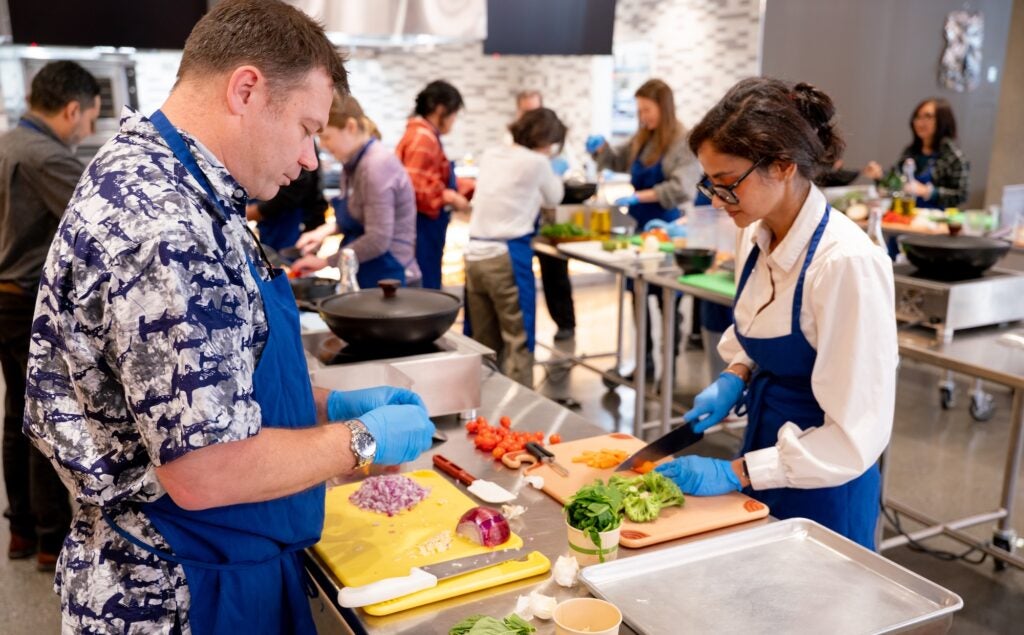
A dozen chefs raced around the Tipuana Teaching Kitchen at UCLA’s Weyburn Terrace Apartments and hurriedly grabbed ingredients before chopping, sauteéing, and frying. While the scene appeared to be pulled straight out of a competition show like Top Chef, these cooks were in fact collectively exploring how instructors can center wellbeing while navigating constraints and competing priorities.
The chefs, consisting of faculty and graduate student instructors, were participants in Nurturing Meaningful Collaborations — a team-based cooking experience hosted by the UCLA Teaching and Learning Center (TLC) as part of its Instructor Wellbeing Initiative. Senior Executive Chef Joey Martin for UCLA Housing and Hospitality guided teams as they prepared group dishes in a limited timeframe with select ingredients. The experience sparked participants’ creative problem-solving skills and camaraderie as they created dishes showcasing their culinary personalities.
Afterwards, groups shared lunch and reflected on takeaways to inform how they respond to current challenges in the classroom. They discussed how to foster faculty and graduate student collaborations, as well as how to make space for individual wellbeing, despite ongoing change throughout higher education.

For the organizers, cooking represented the adaptability and intentionality that instructional teams must often work to bring to their courses.
“Food can be a great way to bring people together and establish common ground for conversation, which can help build the trust that’s required to have deeper conversations,” shared Beth Goodhue, Director of Graduate Student and Postdoctoral Scholar Engagement at the TLC and an event co-facilitator. “In a time of resource constraints, it’s important to make time to build community and collectively strategize about our shared path forward.”
Instructors appreciated the opportunity to meet other educators from across campus for a communal experience.
“Planning and cooking a meal together was a valuable teamwork exercise because we collaborated together toward a common goal, and got to share the meal with other groups,” shared Jennifer Jung-Kim, a lecturer in the Department of Asian Languages and Cultures.
Participants also noted that the challenge highlighted the importance of communication, flexibility, and trust across a team.
“When cooking together, each person naturally took on different tasks—chopping, watching the stove, prepping,” recalled Oke Iroegbu, a Ph.D. candidate in Culture and Performance. “The process worked best when we communicated and coordinated, preventing interference. This experience revealed that effective problem-solving relies on sharing ideas and building on suggestions.”

Nurturing Meaningful Collaborations is part of the TLC’s Instructor Wellbeing Initiative, a series of events and resources promoting individual and professional care throughout the UCLA instructional community. The Initiative’s 2025-2026 programming aims to help instructors see themselves as agents of transformation who can foster welcoming classroom communities. Building off this theme, the organizers hoped that the cooking challenge foregrounded the importance of creating intentional dialogue within instructional teams
“Sometimes we forget how to talk to one another, particularly during times when institutional constraints affect us all in different ways,” explained Sammy Solis, Assistant Director for Teaching Development at the TLC and an event co-facilitator. “I hope that this event fostered a person-first approach, where people could be mindful of their different roles but also communicate across them in more productive ways.”
Participants felt inspired by the experience to integrate more hands-on learning activities into their own courses going forward.
“I am grateful to TLC and UCLA Dining for this unique experience,” said Jung-Kim. “I would love to be able to apply for the chance to do this with my class, potentially through a Tier 1 Seed Grant.” More broadly, participants hoped to apply the intention of centering dynamic group engagement to future courses.
“A key lesson I want to carry into future teaching is to create learning experiences that challenge students to work through problems together, not just to passively receive information,” noted Iroegbu. “I saw how problem-solving became more meaningful when everyone contributed ideas and collaborated. I want my classroom to be a space where students feel comfortable experimenting, making mistakes, and solving problems together.”