
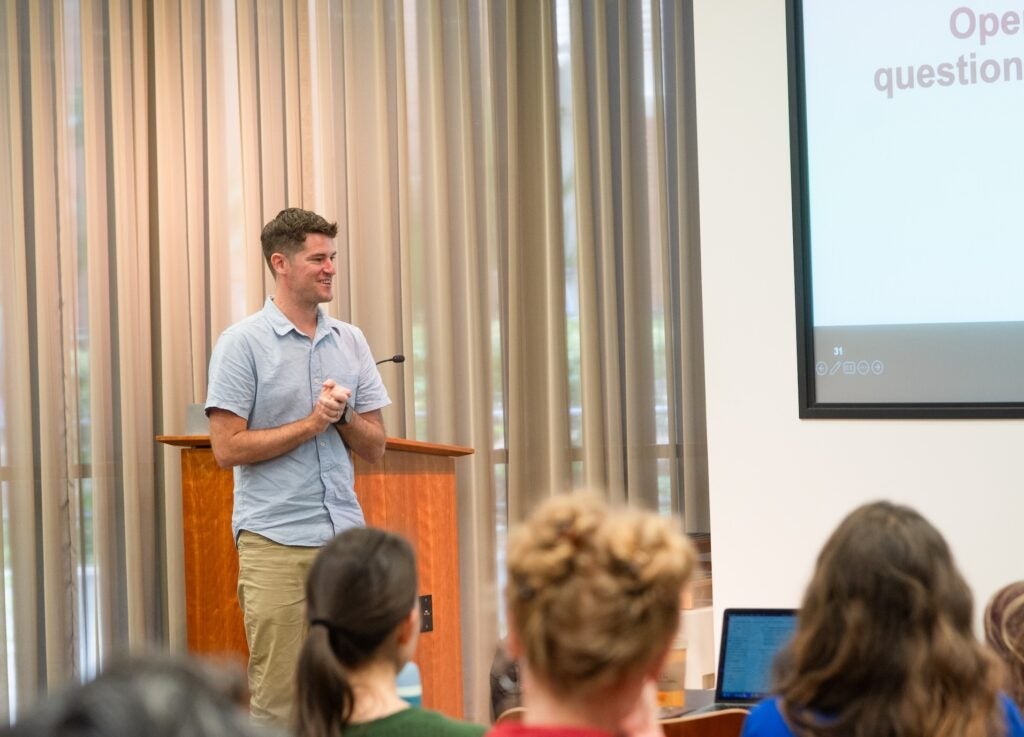
Associate Professor of Teaching Jeff Maloy.
Students in Cell and Molecular Biology (LS7A) spent the end of the lecture huddled in groups comparing class schedules and gathering contact information. While they established community agreements and meeting times, they also selected team names and created logos to represent their group’s spirit. With names like the Nifty Narwhals or Turtle Pod, these groups became an integral part of their learning experience throughout the course.
“Humans are inherently social animals, and so students have always had a thirst to interact with people,” observed Jeff Maloy, an associate professor of teaching in UCLA’s Department of Molecular, Cell, and Developmental Biology who teaches LS7A.
Maloy has used this desire for connection to boost student engagement and understanding of course concepts through learning pods, a peer-based classroom model where small student groups actively work through material. In LS7A, students are assigned to small groups to discuss material and collaborate on assignments. The pod members sit together to talk through discussion questions and work on problem sets throughout the course.
Learning pods collaborate outside of class, too. Podmates are enrolled in the same discussion sections of LS7A and work together on weekly assignments. Besides completing the group phases of exams, the pods function as built-in study groups. While this collective approach is new for many students, they have found that working together strengthens their grasp of course lessons.
“I generally approach academics quite independently and do not collaborate with fellow students often,” noted one student who worked in a learning pod. “However, this course helped me explore the value of working with a team as we are all able to achieve a much deeper understanding of the material through our collective strengths.”
The learning pod model was initially developed to foster student engagement in a radically new classroom environment. The pivot to remote instruction during the COVID-19 pandemic created the need to promote online social interaction. Like many instructors, Maloy tapped his creativity to retain student interaction, which is a key part of the learning process.
“There’s a lot of research that tells us students learn better when they interact, and that they learn better when they’re active in the classroom,” Maloy shared. “We wanted to encourage students to still interact with each other in this virtual Zoom space, when they couldn’t sit next to somebody or just turn to their neighbor and chat or work through a problem.”
While the first learning pods randomly assigned LS7A students to work together on problem sets after a Zoom lecture, the model has evolved over various iterations. Today, learning pods have been adopted across the Life Sciences Core Education sequence, as well as in classrooms across other institutions.
Creating Shared Knowledge
The learning pods model draws on educational scholarship about how students collaboratively create knowledge. Social constructivism is a learning theory asserting that students build meaningful understandings of course concepts through active communication and building on their previous experiences. Research finds that effective learning occurs when students have opportunities to interact with each other and start a dialogue based on sharing different ideas.
“Students are more productive when you put them in groups that are diverse in terms of discipline and experience and history,” explained Maloy, “And the reason for that is that the more different experiences and perspectives you have in a group, the more likely those conversations are to be illuminating for different members of the group.”
The learning pods coincide with broader trends in student interaction, where electronic communication offers new opportunities to connect. While self-directed, online interaction offers students more agency, Maloy noted that this communication style can also be more exclusive.
“I think asynchronous electronic communication privileges students who maybe are more outgoing or more willing to put themselves out there,” he explained.
For instance, while one student might feel confident enough to post a question on a class discussion board, another student might think they don’t know enough to post or reach out. In response, Maloy thinks that models like the learning pods offer students guidance for effective engagement with course material.
“I think the shift towards electronic communication has necessitated being able to scaffold that communication with a certain amount of structure that helps to level the playing field for all students,” he noted.
Scaffolding Student Collaboration
Over the past six years, Maloy has continued to refine his approach to learning pods across different offerings of LS7A. Overall, he has found that providing structure to facilitate student collaboration helps encourage collaborative learning and sets groups up for success.
“I think it’s important to give the group some kind of purpose, some kind of specific direction rather than just saying, ‘work together this quarter,’” he shared.
While in practice this might consist of giving group members permanent assigned roles or rotating tasks, concrete direction and consistency remain key for supporting students to form deep relationships and promoting learning through the groups. Maloy also asserted the importance of creating structures for addressing potential conflict.
“People aren’t born with an ability to handle conflict or navigate different group dynamics, and so I think giving groups scaffolded, intentional opportunities to provide feedback and reflect on how they’re doing is important,” he explained. As a result, podmates have a specific structure for providing each other with feedback through continuous group evaluations. Members also complete self-evaluations throughout the quarter that assess ongoing group dynamics.
Maloy urged instructors who are curious about integrating more collaborative learning to gradually add these guided group activities into their courses while being open to modification.
“Pick something small that feels manageable and start with that, and then see what you want to improve,” he said. “Every time I do the learning pods, something about them changes, I iterate, I build, and hopefully I improve.”
Instructors interested in incorporating learning pods in their high-enrollment courses can schedule a consultation with a member of the Teaching and Learning Center team by emailing instructorsupport@teaching.ucla.edu.