

Though many conversations about modern medicine highlight the far-reaching advances gained through scientific progress, these benefits are not always shared equally by all members of society. One might encounter barriers accessing critical medical care due to implicit bias from medical professionals based on factors such as gender or race.
Some scholars believe efforts to combat these care inequities might begin in the classroom.
“How many of the STEM classes you took incorporated a justice-oriented curriculum?” asked Brie Tripp, an associate professor of teaching at the University of California, Davis. The audience of instructors held up numbers with their hands, with the vast majority being zero or one. Such results highlighted how rarely undergraduate curricula showcase science’s potential to both perpetuate disparities and promote change.
In her talk, “Taking off the Rose-Colored Glasses: How Justice-Centered Science Curricula Raises Pre-Health Undergraduates’ Critical Consciousness,” Tripp presented on STEM education approaches that address health disparities rooted in implicit bias. Tripp began this academic year’s Educational Innovation and Scholarly Teaching Seminar series, where pedagogical researchers share their insights with UCLA instructors. The series is sponsored by the Vice Provost for Teaching and Learning and hosted by the UCLA Teaching and Learning Center (TLC).
Tripp examined her research into how undergraduate pre-health majors’ implicit biases impact health care. Through the Tripp Lab at UC Davis, she hired undergraduate researchers with lived experiences of injustice to co-create case studies to integrate into the curriculum of an upper-division human physiology course. For instance, a case study on stress responses amongst members of the unhoused population was integrated in the course’s immunology lecture, while another on discrimination against those with obesity was part of the lecture on the digestive system. After students examined pathophysiology information and health disparity data, questions guided them in connecting physiology content with broader social issues and advocacy efforts.
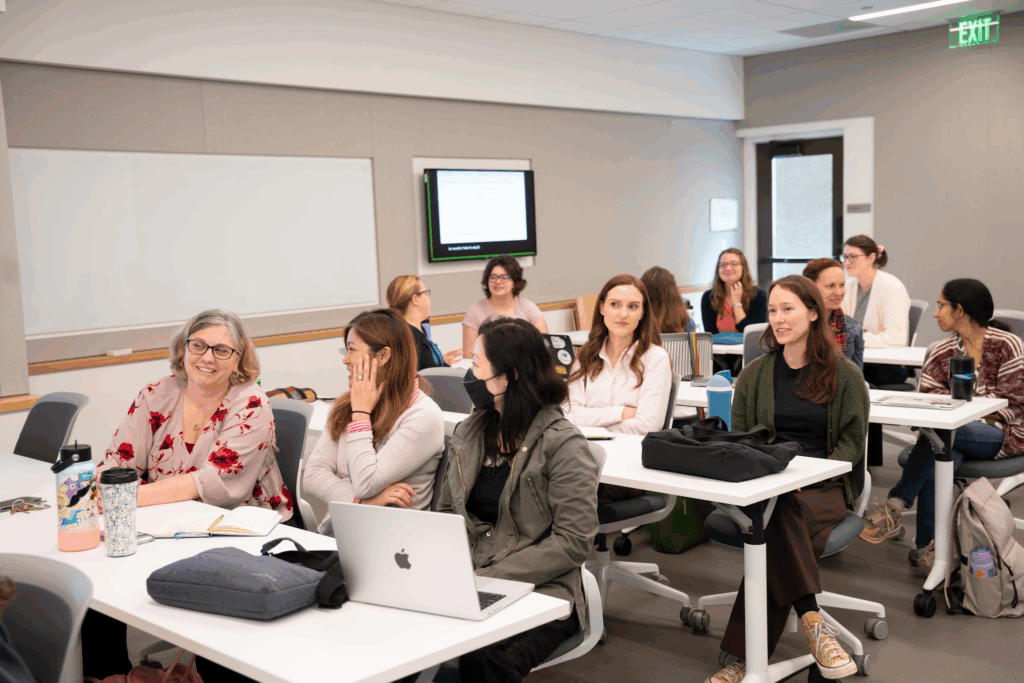
Many instructors who attended the seminar found that Tripp’s research offered a powerful example of how to build student empathy and engagement within science courses.
“This kind of justice-centered curricula is valuable to me as an instructor because it prepares our students to be more caring and effective STEM professionals,” noted Tyler Andres-Bray, an assistant professor of teaching in the Department of Ecology & Evolutionary Biology. “As a new assistant professor of teaching at UCLA, I view Dr. Tripp as an exemplar for engaging undergraduates in meaningful research and creating positive change in our academic communities.”
Central to Tripp’s approach throughout the case studies is the idea of raising pre-health students’ critical consciousness, a concept developed by educational theorist Paulo Freire, denoting one’s ability to identify oppressive sociopolitical forces and to then take action against them. She highlighted that teaching students about how medicine can create and perpetuate disparities can make them more conscientious throughout their future professional careers.
“Promoting the development of pre-health undergraduates’ critical consciousness enhances their awareness of systems of oppression that produce health disparities and also strengthens their confidence to act in solidarity with communities most impacted by health injustice in their future medical careers,” Tripp shared.
The seminar then examined the measured impact of this justice-centered curriculum on pre-health majors’ development of critical consciousness. Tripp and undergraduate researchers conducted interviews regarding their perception of the material with students before and after the courses that integrated the case studies. The vast majority demonstrated expanding critical reflection on the structural oppression leading to these inequities upon completion of the studies.
Tripp hopes that participants ultimately saw the value of student-produced case studies in promoting a socially-responsive STEM education.
“Centering the voices of students from underserved backgrounds to co-create justice-centered STEM curricula reduces what Paulo Freire calls the ‘banking model of education,’ she noted. “As instructors, we need to involve their perspectives and lived experiences into our classroom to make change, and student-authored curricula is one way to accomplish this.”
Going forward, attendees felt inspired to adapt their courses to include more elements of justice-centered pedagogy.
“To reduce these disparities in health and science, it’s important for our students to learn about them early and often, and Dr. Tripp’s work demonstrated that students are overwhelmingly both underinformed and eager to learn about inequity,” shared Andres-Bray.