
Direct and Indirect Assessment of Student Learning
September 2026

What?
Direct and indirect assessment are complementary strategies used to evaluate student learning and strengthen instructional effectiveness. These approaches help instructors at UCLA and beyond verify whether learning outcomes are being achieved, understand the student experience, and make evidence-based improvements to course and program design.
Assessment literature emphasizes the need for multiple forms of evidence, as no single method provides a full picture of learning (Banta & Palomba, 2015; Kuh et al., 2015; Suskie, 2018).
Direct Assessment
Direct assessment measures observable evidence of student learning through performance, demonstrated skills, or artifacts evaluated against explicit criteria (e.g., standardized tests, portfolios, presentations, or capstone projects). These measures verify whether students can perform tasks or apply knowledge aligned with stated learning outcomes (Banta & Blaich, 2011; Clough & Vander Schaaf, 2017). Direct assessment provides instructors with concrete evidence of student achievement and supports data-informed improvements to curriculum and pedagogy.
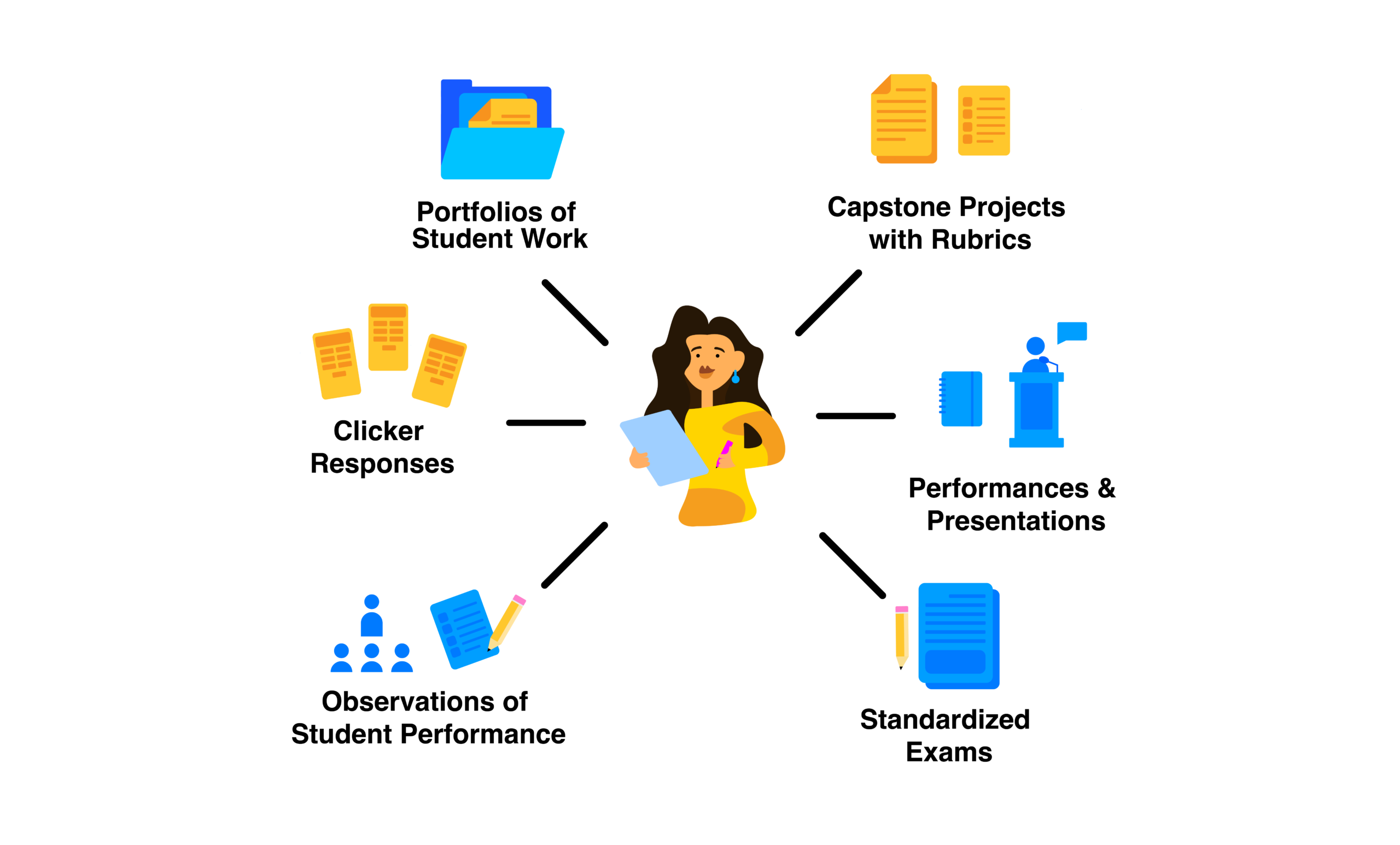
Direct Assessment Examples
Psychology – PSYCH 100B (Research Methods in Psychology)
UCLA’s PSYCH 100B course description states that students complete laboratory activities involving experimental and non-experimental research methods, statistical design, and data analysis. Students produce lab assignments, conduct statistical analyses, and write formal research reports. These artifacts constitute direct assessment because they require students to demonstrate methodological understanding, apply statistical reasoning, interpret findings, and communicate results using disciplinary conventions. Faculty evaluate these products using defined criteria aligned with course learning outcomes in research design and empirical reasoning.
Simulations (Health Education)
Students training to be medical professionals often receive direct assessments through simulation-based learning experiences. The UCLA Simulation Center offers a laboratory setting for students to practice physical assessments, advanced medical surgical procedures and ICU skills training. Faculty can directly assess clinical competencies during these simulations using standardized checklists of performance criteria.
Recitals (Music Performance)
In music performance, end-of-term recitals — where students perform an extensively rehearsed piece for the public, as well as their advisors — are often a capstone assessment used to directly gauge students’ technical proficiency and artistic development. Music recitals at the UCLA Herb Alpert School of Music have students regularly perform public instrument and voice recitals (e.g., senior voice, piano, and instrumental performances) in campus venues such as Lani Hall and the Schoenberg Music Building.
Seminar Papers (Humanities)
Direct assessments for graduate students in the humanities often take the form of final seminar papers where students conduct individual research applying theoretical frameworks from the course and developing an original argument in conversation with relevant scholarship. At UCLA, for example, the Graduate Writing Center’s “Writing in the Humanities: The Seminar Paper and Beyond” workshop highlights seminar papers as a core genre of humanities writing, emphasizing that skills such as developing an original argument, conducting literature reviews, and revising scholarly work are key components that faculty use to directly assess students’ analytical and research competencies.
Indirect Assessment
Indirect assessment captures perceptions, beliefs, attitudes, and reflections related to learning (e.g., student surveys, course evaluations, focus groups, or self-reflections). These measures offer insight into students’ experiences, self-efficacy, and perceived challenges (Umbach & Porter, 2002; National Research Council, 2012). While indirect evidence cannot confirm learning, it contextualizes direct results and reveals factors influencing performance. Because many variables affect demonstrated performance, shifts in direct learning may be difficult to detect — especially over short time frames. Indirect measures can reveal earlier changes in confidence, motivation, or perceived understanding that often correlate with later performance gains.
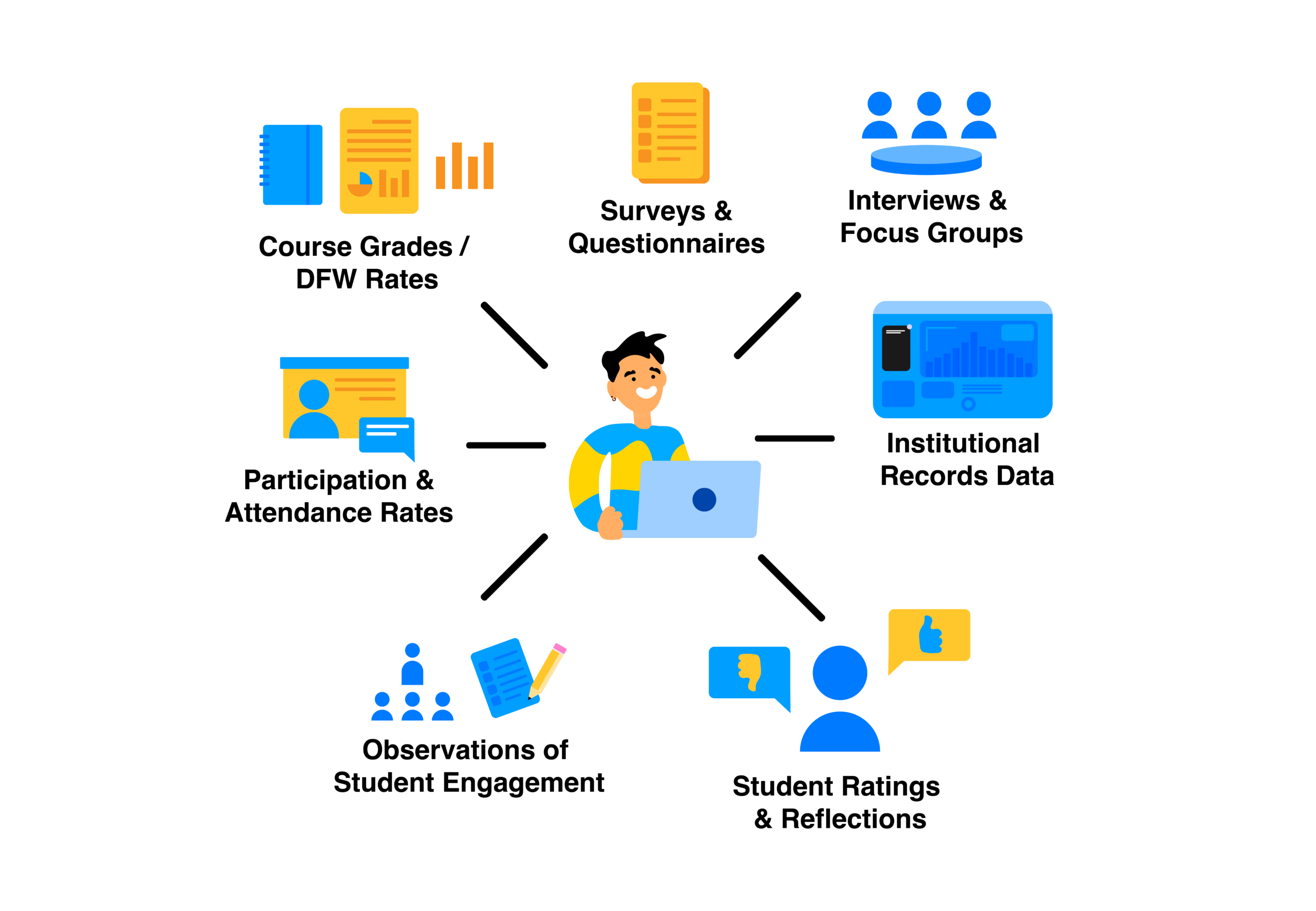
Indirect Assessment Examples
Reflective Writing (English Composition)
Writing instructors often emphasize iterative drafting, feedback, and revision. In order to support students process their feedback, as well as garner data about student progress, instructors may ask students to comment on their own progress, workload, and areas of challenge. Instructors can use student responses as indirect evidence of students’ perceptions on their own writing development, the clarity of assignments, and confidence with academic communication. Reflection prompts may be used in any introductory-level general education setting where students are engaged in the process of learning how to be students.
Sociology 20 – Introduction to Sociological Research Methods
Students in Sociology 20 develop foundational skills in research design, data collection, and analysis across quantitative and qualitative approaches. In one assignment sequence, students design and administer a brief survey examining preferences for trash cans with lids versus without lids at building entrances. They then conduct a structured observational study by placing lids on selected trash cans while leaving others open and tracking usage patterns as individuals exit the building. Students then analyze both survey and observational data and write a report presenting findings and evidence-based recommendations about when lids are most effective.
Student Feedback Surveys (UCLA Undergraduate Capstone Initiative)
The Capstone Initiative at UCLA describes capstone experiences across many engineering majors, including team-based projects, design challenges, and culminating presentations. Programs commonly gather student feedback surveys on teamwork, project experiences, and perceived preparedness for professional practice. These reflections provide indirect insights into effective dimensions of learning such as collaboration, confidence, and perceived skill development. These types of student feedback surveys may be used for indirect assessment in any courses where students are engaging in project and team-based learning.
Post-Experience Surveys and Research Reflections (Undergraduate Research Centers)
UCLAundergraduates can hone their research and presentation skills by working with the Undergraduate Research Center — Sciences (URC-Sciences) or the Undergraduate Research Center — Humanities, Arts, and Social Sciences (URC-HASS). URC–Sciences notes that research participation helps students build confidence in their ability to analyze literature, present data, and communicate scientific findings. Students present their projects during Undergraduate Research Week, after which they are asked to fill out post-experience surveys and complete research reflections. These offer indirect indicators of student self-efficacy and perceived growth as developing researchers.
Check-Ins and In-Class Polling
In-class polling can be used to check in informally with students in any course. Instructors can view a range of campus-approved tools (e.g., Bruin Learn quizzes and surveys, Zoom polling; learn more on the UCLA Digital & Technology Solutions website) to indirectly assess students’ experiences with pacing, workload, clarity of instructions, and technology. Other tools (e.g., iClicker, Poll Everywhere) may also be used where appropriate (see a DTS example for polling). These perception-based inputs allow instructors to identify barriers such as confusion about navigation, need for additional scaffolding, or challenges with course tools — factors that inform improvements to instructional design.
Classroom Assessment Technique: Think–Pair–Share
During this activity, students are presented with a question and given time to think about their responses. Sometimes they might submit an initial answer through an in-class polling tool (e.g., clickers). Before the instructor provides the correct answer or response, students discuss their thinking with a classmate. The instructor then brings the class back together, asks students to respond to the same question via in-class polling, and opens the floor for discussion or clarification. This approach aligns with Classroom Assessment Techniques (CATs) as described by Angelo and Cross (1993), which are formative, in-class strategies designed to provide immediate feedback on what and how well students are learning, with the goal of improving instruction. For a comprehensive overview of CATs and additional examples, see Indiana University’s CAT resources.
Why?
Together, direct and indirect assessments offer a more complete understanding of student learning than either approach alone. Using both strengthens instructional decision-making and supports continuous improvement at the course and program levels.
Direct Assessment: Evidence-Based Rationale
Direct assessment provides the strongest evidence of student learning because it evaluates actual student performance, not self-perceptions (Luce & Kirnan, 2016). This supports instructional improvement, verifies alignment with learning objectives, and generates defensible evidence for accreditation and quality assurance processes (Banta & Palomba, 2015). Structured evaluation criteria — such as rubrics or task-specific checklists — also increase scoring consistency and transparency (Brookhart, 2013).
These principles can be seen across numerous UCLA programs where student work naturally produces authentic, discipline-grounded evidence of learning.
Evidence
Cluster Program (General Education)
UCLA’s GE Cluster Program requires first-year students to complete written assignments, collaborative projects, and a research paper or presentation as part of its yearlong interdisciplinary curriculum. These culminating assignments serve as direct evidence of students’ ability to integrate course themes, conduct inquiry, and communicate findings.
UCLA Library Instruction & Scholarship Programs
The UCLA Library’s programs (e.g., research workshops, undergraduate library instruction) require students to produce search strategies, annotated bibliographies, or research plans that librarians evaluate for information-literacy competency — providing direct assessment of research and critical-evaluation skills.
School of the Arts and Architecture Performances
Many programs in the UCLA School of the Arts and Architecture require students to participate in performances, exhibitions, or juried reviews. For example, students in the Department of Theater present staged productions and design showcases; music students perform in ensembles, recitals, and concerts; and art and architecture students exhibit work in curated shows, studios, or final reviews. These public-facing artifacts often presented in venues such as campus theaters, galleries, and performance halls, are typically evaluated using discipline-specific rubrics and serve as direct assessments of technical skill, artistic interpretation, and creative development.
Indirect Assessment: Evidence-Based Rationale
Indirect assessment provides insight into students’ experiences, confidence, perceived clarity, sense of belonging, and barriers to learning (National Research Council, 2012; Pintrich, 2004). These perception-based measures help instructors understand why performance outcomes look the way they do and guide adjustments to course design, pacing, or support structures.
Many UCLA programs illustrate how systematically collected student perceptions and reflections can inform meaningful instructional and programmatic improvements.
Evidence
UCLA Undergraduate Experience Survey (UCUES)
UCLA participates in the University of California Undergraduate Experience Survey, which collects large-scale data on students’ academic engagement, time spent on coursework, perceived learning gains, and sense of belonging. These institution-level results provide indirect evidence of students’ academic experiences and inform curricular improvement across departments
Center for Community Engagement – Community-Based Learning
UCLA’s community-engaged courses often include student reflections or post-course surveys on civic learning, community partnerships, and personal growth. These narratives serve as indirect evidence of students’ perceived development of civic responsibility, communication skills, and applied learning.
Academic Success Programs – UCLA Residential Life
Residential Life’s academic programs (e.g., College Academic Mentors, writing support) collect student reflections and satisfaction data to understand perceived progress, clarity of academic expectations, and self-efficacy related to study strategies. For example, the College Academic Mentoring (CAM) program pairs undergraduates with trained peer mentors who facilitate workshops and offer one-on-one academic support. Students often complete feedback forms or reflections on their confidence, study habits, and understanding of course expectations following these sessions. These reflections are used as indirect indicators of students’ academic development within co-curricular learning environments.
Why Use Both? Triangulation for a Holistic View of Learning
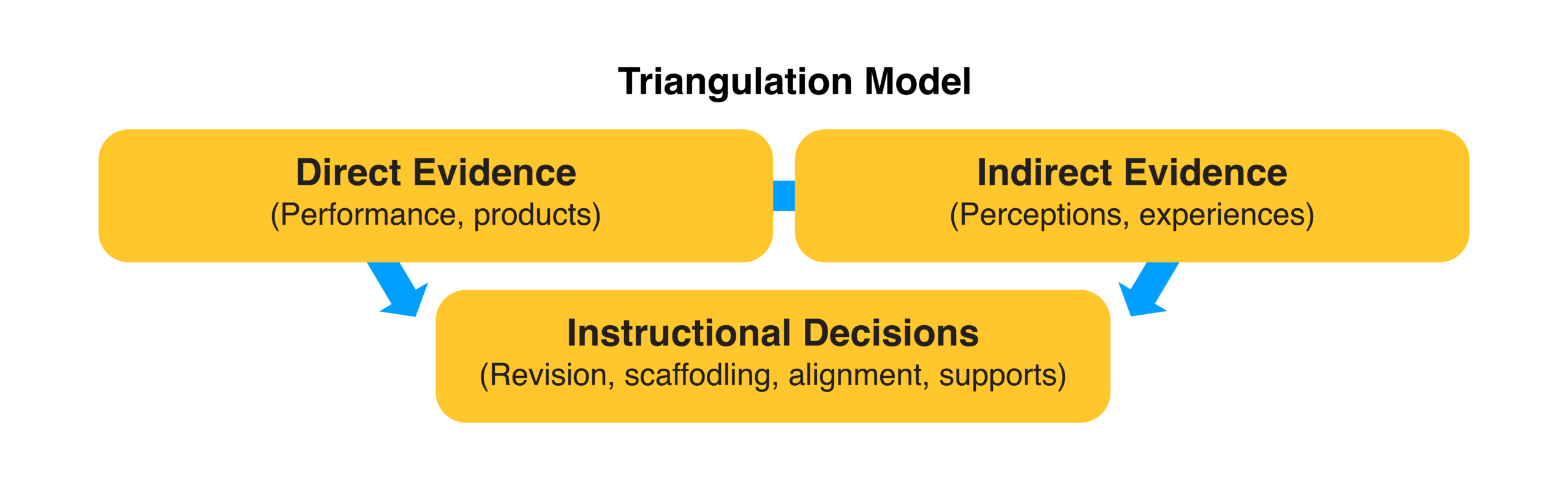
Direct and indirect assessments provide complementary insights into student learning. When used together, they support triangulation, a widely recommended practice that compares multiple sources of evidence to produce a more accurate and nuanced understanding of student achievement (Kuh et al., 2015; Vlachopoulos & Makri, 2024). Triangulation helps instructors validate findings, identify discrepancies between perceived and actual learning, and make informed instructional decisions grounded in both performance and student experience.
Triangulation Example
- Direct evidence: Students underperform on data literacy assignments, demonstrating difficulty interpreting results or applying statistical concepts.
- Indirect evidence: Reflection prompts and mid-quarter feedback indicate that students felt confused by assignment expectations and uncertain about how to begin the analysis.
- Interpretation: Together, these signals suggest that the issue may be related to cognitive load and insufficient scaffolding rather than content difficulty alone (Sweller et al., 2019). Instructors might respond by clarifying instructions, modeling sample analyses, or slowing the pacing of new concepts.

How?
Assessment design must account for class size, disciplinary norms, and course modality, as each shapes what forms of direct and indirect evidence are feasible and meaningful. The examples below draw on published research and documented practices in higher education, providing real, credible scenarios instructors can learn from.
Disclaimer: References to course “size” are inherently relative and should be interpreted within the context of the discipline, subject matter, and learning objectives of a given course. What constitutes a “small” or “large” class varies significantly across fields and instructional settings. The examples that follow are intended to provide general guidance rather than prescriptive models, and should be adapted to align with specific course goals and constraints.
Class Size Considerations
Small Seminar Courses (≤ 25 students)
Small seminars support high-feedback, relational pedagogy and make it feasible to integrate open-ended, iterative assessments. Iterative approaches like multi-draft writing, staged projects, or repeated practice with feedback deepen understanding by allowing students to refine their thinking across cycles of feedback (Hattie & Timperley, 2007; Sadler, 2010). These settings also encourage formative writing, structured discussion, and metacognitive reflection, which together provide rich direct and indirect evidence of learning (Tanner, 2012).
Because small seminars allow instructors to closely observe individual thinking in real time, researchers have documented learning challenges that would be difficult to detect in larger courses. For example, in a philosophy seminar study, students successfully completed structured argument-recognition exercises (direct evidence), yet during close-reading discussions, the instructor noticed that several misinterpreted key premises in complex texts (Nussbaum, 2013). When students later wrote short reflection journals, many expressed confidence in their analytical abilities despite these misinterpretations (indirect evidence). The small class format made it possible for the instructor to triangulate performance, discussion behavior, and reflective writing, revealing a subtle gap between students’ perceived and actual analytical proficiency — insight unlikely to emerge in a large lecture setting.
Medium-Sized Courses (25–100 students)
Medium-enrollment courses balance the individualized feedback possible in small seminars with the structure needed in larger classes. Instructors can combine targeted direct assessments — such as short written assignments or problem-solving tasks — with efficient indirect measures like brief surveys or peer evaluations. These settings are particularly well-suited for team-based or collaborative learning, which can generate strong direct evidence of conceptual application alongside indirect insights into students’ perceived understanding (Michaelsen & Sweet, 2008).
Because medium-sized classes allow instructors to circulate among several groups without becoming overwhelmed, researchers have documented diagnostic opportunities that are unlikely in large lectures.
In a study of a mid-sized economics course, for example, instructors assigned complex analytical problem sets to student teams and observed their collaborative reasoning in real time (direct evidence). During these sessions, instructors noticed that some groups stalled not because they lacked conceptual knowledge, but because they disagreed on how to structure their approach. Short preparedness and confidence surveys administered at the end of class (indirect evidence) confirmed that students struggled more with process coordination than with content itself. This triangulated insight guided the instructor to introduce structured problem-solving heuristics in subsequent weeks, which significantly improved group performance and individual exam outcomes (Hora & Oleson, 2017).
Large Lecture Courses (100–400+ students)
Large courses require scalable and reliable assessment systems. Digital tools and structured rubrics support consistency (Kite et al., 2020), and frequent low-stakes quizzes promote retention (Agarwal et al., 2012).
A study in a 1,000-student general chemistry sequence found something unexpected: students’ scores on early stoichiometry and equilibrium questions dropped sharply not when content difficulty increased, but when students simultaneously reported confusion about course navigation, assignment sequencing, and lab scheduling on weekly check-ins (Rodriguez et al., 2019). Many students indicated that they spent excessive time trying to locate due dates, interpret lab instructions, or understand how lecture and discussion materials were connected.
Triangulating direct (quiz scores, exam performance) and indirect (perception surveys) evidence revealed a clear pattern: logistical and cognitive overload, not content mastery, was suppressing performance. Once instructors streamlined weekly modules, clarified lab workflows, and introduced short “getting started” guides for each unit, students’ exam performance and self-reported confidence improved markedly.
Discipline-Specific Considerations
STEM Disciplines
STEM fields often emphasize procedural accuracy, problem solving, and conceptual transfer.
- Direct assessment: lab reports, worked problems, design challenges, computational assignments.
- Indirect assessment: confidence inventories; lab-process reflections; perceived difficulty scales; “muddiest point” submissions; mid-quarter feedback on learning strategies and course expectations.
In engineering education, Hiebert & Stigler (2017) found that combining lab-performance rubrics with student process reflections helped instructors distinguish between conceptual misunderstandings and procedural errors, improving targeted feedback to students.
Humanities
Humanities instruction often centers on interpretation, argumentation, and ethical reasoning.
- Direct assessment: essays, textual analyses, multimodal portfolios.
- Indirect assessment: reflective writing about interpretive strategies and learning processes.
A national writing-program study found that students’ reflective essays revealed gaps in their understanding of rhetorical purpose, even when their final essays met rubric criteria (Yancey, 2016). This triangulation allowed instructors to revise scaffolding around writing processes.
Social Sciences
Social sciences often blend empirical research with theoretical applications.
- Direct assessment: research designs, data analyses, literature reviews, case evaluations.
- Indirect assessment: self-efficacy surveys, reflections on methodological challenges.
In political science, Ishiyama (2019) showed that pairing research paper rubrics with post-assignment self-evaluations improved students’ understanding of research methodology and reduced overestimation of their skills, highlighting the value of triangulation.
Arts & Design Fields
Creative disciplines rely heavily on studio critique and public presentation.
- Direct assessment: performance, portfolio reviews, juried critique.
- Indirect assessment: artist statements, self-critiques, process journals.
Barrett (2011) found that integrating portfolio assessment with reflective artist statements provided instructors with insight into conceptual development that was not fully apparent in the final artifact alone.
Professional & Clinical Programs
Professional fields assess readiness for real-world practice.
- Direct assessment: clinical simulations, OSCEs, supervised practice evaluations.
- Indirect assessment: self-assessed competency scales, reflective debriefing.
In nursing education, Gantt (2010) demonstrated that combining simulation performance rubrics with post-simulation reflective surveys revealed mismatches between students’ perceived and demonstrated preparedness, guiding targeted remediation.
Modality Considerations
Different instructional modalities create distinct opportunities and constraints for assessment. Effective assessment design considers how students interact with content, peers, and instructors within each modality, ensuring that both direct and indirect evidence of learning can be collected meaningfully.
Face-to-Face / Synchronous Courses
Face-to-face environments support a wide range of direct assessment activities, such as presentations, exams, demonstrations, and lab practicals. These settings also enable instructors to gather indirect evidence through short reflective prompts, exit tickets, or small-group debriefs that surface confusion or perceptions of challenge in real time.
Classroom assessment techniques (e.g., the “one-minute paper”) have been shown to quickly reveal student misconceptions and guide immediate instructional adjustments (Angelo & Cross, 1993).
Example: One-Minute Paper
At the end of a class session, an instructor asks students to spend one minute responding to two prompts: “What was the most important concept you learned today?” and “What question remains unclear?” Students submit their responses on paper or through a course platform (e.g., Bruin Learn). The instructor quickly reviews responses to identify common themes such as widespread confusion about a key concept or gaps in understanding, and uses this feedback to adjust the next class session. This technique provides indirect evidence of student learning by capturing students’ perceptions of their understanding in real time.
Online Synchronous Courses
Synchronous online instruction supports immediate interaction similar to the physical classroom.
- Direct assessment may include real-time problem-solving activities, oral explanations, or collaborative breakout tasks.
- Indirect assessment can be captured through Zoom polls, chat-based check-ins, or micro-reflections that help instructors gauge students’ perceptions of clarity, pacing, and workload.
Synchronous polling and chat interactions improve students’ sense of presence and provide instructors with actionable indirect evidence to adjust pacing and clarify content (Martin et al., 2020).
Online Asynchronous Courses
Asynchronous courses require flexible, transparent, and well-structured assessments to support self-paced engagement.
- Direct assessment often includes multimedia projects, auto-graded quizzes, coding assignments, simulations, or discussion-based analysis.
- Indirect assessment can be gathered through learning analytics (e.g., time-on-task patterns, clickstream data) and weekly reflective prompts that reveal students’ perceptions of difficulty or confusion.
Studies show that triangulating LMS analytics with self-reported reflections helps instructors identify design issues or cognitive bottlenecks that may not be visible through direct assessments alone (Ifenthaler & Yau, 2020).
In a large-scale study of online STEM courses, students frequently reported challenges with software setup and digital tools; when instructors added step-by-step technical walkthroughs and troubleshooting guides, performance on early assignments improved significantly. This finding aligns with research indicating that reducing technological barriers is essential for supporting cognitive engagement in online environments (Weston et al., 2021).
Getting Started
Implementing a balanced assessment strategy does not require a major course redesign. Faculty can begin with a small set of intentional steps that align assessment practices with learning goals and support continuous improvement.
Step 1: Identify or Refine Learning Outcomes
Ensure that course learning outcomes are specific, measurable, and observable, using action verbs aligned with Bloom’s Revised taxonomy (Anderson & Krathwohl, 2001). Clear outcomes make it easier to select assessments that accurately capture the knowledge or skills students are expected to demonstrate.
Step 2: Select Direct Measures
Choose direct assessments that align tightly with the intended outcomes such as exams, projects, lab reports, performances, or written assignments (Suskie, 2018). Strong direct measures make expectations transparent for students and allow instructors to evaluate actual performance against defined criteria.
Step 3: Add Indirect Measures
Integrate one or two complementary indirect tools (e.g., self-assessments, surveys, short reflections, confidence ratings) to help contextualize direct results (Umbach & Porter, 2002). These measures reveal how students interpret instructions, where they feel uncertain, and what they perceive as challenging or engaging.
Step 4: Close the Loop
Review both direct and indirect evidence to identify patterns and inform adjustments to teaching practices, assignment design, pacing, or support structures (Blaich & Wise, 2011). “Closing the loop” ensures that assessment findings translate into meaningful instructional improvements.
Citing this Guide
Teaching and Learning Center (TLC).(2026). Direct and Indirect Assessment of Student Learning. Teaching and Learning Center at the University of California, Los Angeles. Retrieved [today’s date].
Additional Resources
- Rubric design & learning outcomes: AAC&U VALUE Rubrics, NILOA (National Institute for Learning Outcomes Assessment)
- UCLA assessment support: UCLA Teaching & Learning Center consultations/resources
- Direct assessment & scoring: Gradescope
- Formative assessment / classroom feedback: iClicker
References
ABET. (2022). Criteria for accrediting engineering programs, 2022–2023. ABET. https://www.abet.org/accreditation/accreditation-criteria/criteria-for-accrediting-engineering-programs-2022-2023/
Agarwal, P. K., Bain, P. M., & Chamberlain, R. W. (2012). The value of applied research: Retrieval practice improves classroom learning and recommendations from a teacher, a principal, and a scientist. Educational Psychology Review, 24(3), 437–448. https://doi.org/10.1007/s10648-012-9210-2
Ambrose, S. A., Bridges, M. W., DiPietro, M., Lovett, M. C., & Norman, M. K. (2010). How learning works: Seven research-based principles for smart teaching. Jossey-Bass.
Anderson, L. W., & Krathwohl, D. R. (Eds.). (2001). A taxonomy for learning, teaching, and assessing: A revision of Bloom’s taxonomy of educational objectives. Longman.
Angelo, T. A., & Cross, K. P. (1993). Classroom assessment techniques: A handbook for college teachers (2nd ed.). Jossey-Bass.
Arum, R., & Roksa, J. (2014). Aspiring adults adrift: Tentative transitions of college graduates. University of Chicago Press.
Banta, T. W., & Blaich, C. (2011). Closing the assessment loop. Change: The Magazine of Higher Learning, 43(1), 22–27. https://doi.org/10.1080/00091383.2011.538642
Banta, T. W., & Palomba, C. A. (2015). Assessment essentials: Planning, implementing, and improving assessment in higher education (2nd ed.). Jossey-Bass.
Black, P., & Wiliam, D. (2009). Developing the theory of formative assessment. Educational Assessment, Evaluation and Accountability, 21(1), 5–31. https://doi.org/10.1007/s11092-008-9068-5
Blaich, C., & Wise, K. (2011). From gathering to using assessment results: Lessons from the Wabash National Study (NILOA Occasional Paper No. 8). National Institute for Learning Outcomes Assessment. https://www.learningoutcomesassessment.org/wp-content/uploads/2019/02/OccasionalPaper8.pdf
Brookhart, S. M. (2013). How to create and use rubrics for formative assessment and grading. ASCD.
Clough, M. P., & Vander Schaaf, R. (2017). Performance measures in lab-based STEM courses. Journal of College Science Teaching, 46(5), 75–83.
Eyler, J. (2009). The power of experiential education. Liberal Education, 95(4), 24–31.
Gantt, L. T. (2010). Using the Clark Simulation Evaluation Rubric with associate degree and baccalaureate nursing students. Nursing Education Perspectives, 31(5), 308–312.
Ifenthaler, D., & Yau, J. Y.-K. (2020). Utilising learning analytics to support study success in higher education: A systematic review. Educational Technology Research and Development, 68(4), 1961–1990. https://doi.org/10.1007/s11423-020-09788-z
Kite, M. E., Stockdale, G. D., & Flora, K. L., (2020). Effectiveness of digital grading tools. Scholarship of Teaching and Learning in Psychology, 6(4), 296–310.
Kuh, G. D., Ikenberry, S. O., Jankowski, N. A., Cain, T. R., Ewell, P. T., Hutchings, P., & Kinzie, J. (2015). Using evidence of student learning to improve higher education. Jossey-Bass.
Luce, C., & Kirnan, J. P. (2016). Using indirect vs. direct measures in the summative assessment of student learning in higher education. Research & Practice in Assessment, 11(1), 19–31.
National Research Council. (2012). Education for life and work: Developing transferable knowledge and skills in the 21st century. National Academies Press. https://doi.org/10.17226/13398
Pintrich, P. R. (2004). A conceptual framework for assessing motivation and self-regulated learning in college students. Educational Psychology Review, 16(4), 385–407. https://doi.org/10.1007/s10648-004-0006-x
Suskie, L. (2018). Assessing student learning: A common-sense guide (3rd ed.). Jossey-Bass.
Sweller, J., van Merriënboer, J. J. G., & Paas, F. (2019). Cognitive architecture and instructional design: 20 year update. Educational Psychology Review, 31(2), 261–292. https://doi.org/10.1007/s10648-019-09465-5
Swender, E., Adair-Hauck, B., & Glisan, E. W. (2012). ACTFL proficiency guidelines 2012. American Council on the Teaching of Foreign Languages. https://www.actfl.org/educator-resources/actfl-proficiency-guidelines
Tanner, K. D. (2012). Promoting student metacognition. CBE—Life Sciences Education, 11(2), 113–120. https://doi.org/10.1187/cbe.12-03-0033
Umbach, P. D., & Porter, S. R. (2002). How do academic departments impact student satisfaction? Understanding the contextual effects of departments. Research in Higher Education, 43(2), 209–234. https://doi.org/10.1023/A:1014471708162
Vlachopoulos, D., & Makri, A. (2024). A systematic literature review on authentic assessment in higher education: Best practices for the development of 21st century skills, and policy considerations. Studies in Educational Evaluation, 83 Article 101425. https://doi.org/10.1016/j.stueduc.2024.101425
Wilson, D., Bates, R., Scott, E. P., Painter, S. M., & Shaffer, J. (2015). Differences in self-efficacy among women and minorities in STEM. Journal of Women and Minorities in Science and Engineering, 21(1), 27–45. https://doi.org/10.1615/JWomenMinorScienEng.2014005111
Whiteacre, K. (2024). Reconsidering the direct vs. indirect evidence dichotomy. Assessment & Evaluation in Higher Education, 49(3), 1–15. https://doi.org/10.61669/001c.123996