
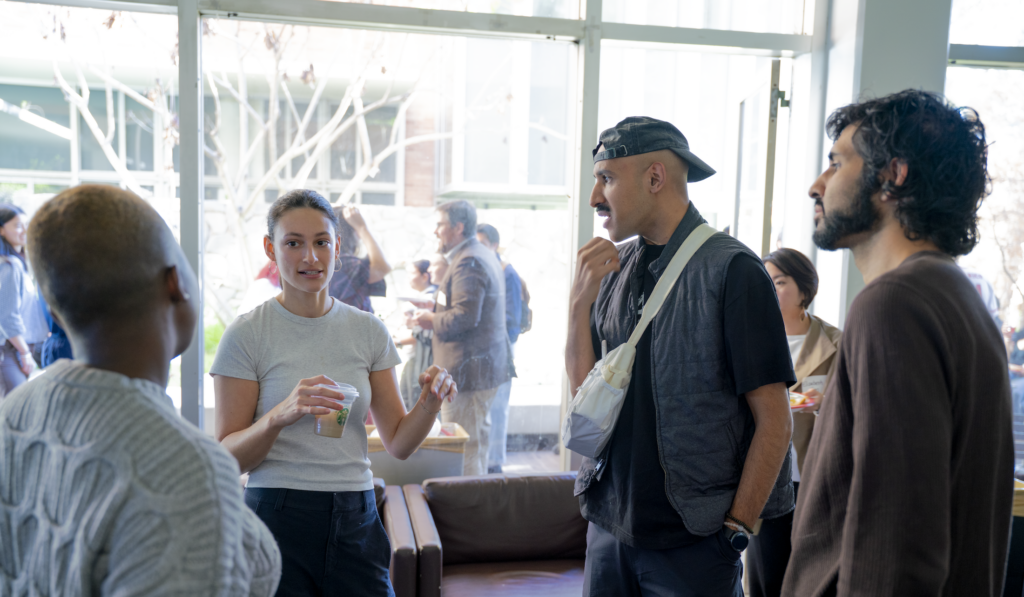
A lively atmosphere filled the Center for Health Sciences’ Health Equity Lab last month as more than 80 students, instructors, staff, and community partners gathered over tamales, a DJ set of salsa and hip hop classics, and presentations on projects undertaken throughout the fall quarter. The event’s welcoming energy celebrated the students’ contributions to public health initiatives across the greater Los Angeles area, while spotlighting the power of embedding community engagement into UCLA classes.
“Community-engaged learning provides students the opportunity to apply what they learn in the classroom in our communities,” explained Angie Denisse Otiniano Verissimo, an associate professor of teaching in the Department of Community Health Sciences. “It allows students to feel connected to broader social justice efforts while recognizing the value of their own lived experiences. Public Health students particularly benefit from community-engaged learning as it taps into their commitment, passion, and love for community work.”
Led by Otiniano Verissimo, Community-Based Participatory Research (CBPR) & Health Equity: Applying the Promotor Model for Social Justice was offered for the first time in the fall of 2025 through the Department of Community Health Sciences at the Fielding School of Public Health. The new course paired students with community health organizations to support projects that included data analysis, survey development, literature reviews, and constructing a virtual reality training for healthcare workers using FrameVR with guidance from the UCLA Blending Research and Instruction in Data-Generated Environments (BRIDGE) Innovation Studio.

The projects and site visits with partner organizations offered students opportunities to learn about community health workers’ research experiences and professional journeys. Paired with what students gathered during classroom sessions, these experiences helped inform how they might integrate community members into all aspects of the research process.
Otiniano Verissimo’s course drew on the promotor, or community health worker, model of engagement. The model highlights frontline public health workers’ role as intermediaries between service providers and community members to provide culturally-competent care. The course aimed to honor promotores by partnering students with local organizations using this model for their projects, including Corazón y Carácter, Latino Health Access, WalkGood LA, and ALMA Backyard Farms.
CBPR students valued the opportunity to meaningfully engage with local communities and earn experience as public health professionals throughout the course. Second-year MPH student Jailene Cruz worked with Corazón y Carácter, a woman-led organization that provides public health training to raise community awareness. She found her experience analyzing the organization’s pre- and post-training survey data greatly enhanced her experience as both a student and aspiring researcher.
“The course was especially meaningful because it genuinely valued our lived experiences and those of the communities we aim to serve,” said Cruz. “Many of my peers and I are first-generation students from underserved communities, and this course allowed us to draw from our own perspectives to better understand what truly works in community settings.”
The CPBR course comes as part of a broader initiative to integrate community-engaged learning into the Fielding School of Public Health’s curriculum. This includes the Project SPARK (Students & Partners Advancing Real-world Knowledge) Learning Community, which supports faculty, staff, postdoctoral scholars, and teaching assistants in exploring how to use community engagement. The initiative advances efforts to foster partnerships across Los Angeles aligned with the UCLA Connects flagship initiative of Chancellor Julio Frenk’s One UCLA campaign and Goal 1 of the UCLA Strategic Plan.
Both the CBPR course and Project SPARK received support through the UCLA Teaching and Learning Center’s (TLC) Implementation Grant, which supports teams of instructors working towards integrated reforms of the curriculum. Through her involvement, Otiniano Verissimo has spotlighted the impact that intentional relationship-building with groups beyond campus plays in elevating student learning.
“Dr. Otiniano Verissimo provides a great model of how to foster meaningful community relationships,” shared Sammy Solis, Assistant Director for Teaching Development at the TLC, who has worked to support Project SPARK to design community-engaged courses to advance health equity.

Ultimately, Otiniano Verissimo’s efforts to integrate community-engaged learning at the Fielding School of Public Health have reinforced students’ commitment to pursuing intentional collaborations throughout their careers.
“This experience has strengthened my commitment to pursuing community-engaged work and carrying the principles of CBPR and the promotor model into my academic, professional, and community efforts by centering community voice and conducting research with and not on communities,” shared Cruz.